Study proposes ionospheric cut-off as a radio technosignature
Researchers examined how a planet's ionosphere blocks low-frequency radio waves from its surface. Using a Chapman-layer model, they found the plasma frequency typically lies between 5 and 40 MHz for habitable-zone worlds, possibly reaching 100 MHz under extreme conditions. The resulting cutoff would shift by about 40-50 % over an orbit, tied to the star's X-ray-UV output and orbital phase, offering a distinctive, though observationally demanding, signal of artificial emissions.
The NASA Exoplanet Archive lists a new planet, RX J0534.0-0221 b, discovered in 2026 by imaging with the James Webb Space Telescope. The planet orbits the star RX J0534.0-0221, lies about 34.4 parsecs (112 light-years) away, and has a reported radius of 14.3 Earth radii and a mass of roughly 890 Earth masses.
3D model tracks mass transfer in binary black-hole progenitor
The authors combined 3D hydrodynamics with the stellar evolution code MESA to follow mass transfer in a low-metallicity binary consisting of a 30 M⊙ donor star and a 9.3 M⊙ black hole from the end of the main sequence to core carbon depletion. Two full Case B mass-transfer phases were simulated in three dimensions, confirming that the Kolb & Ritter prescription matches most of the evolution but overestimates L3 overflow early on. The 3D model stayed within the outer Lagrange point and produced modest L2/L3 outflows that could affect X-ray signals but not the merger time.
Long March 2F/G | Shenzhou 24 is currently listed as Go for Launch, with a no-earlier-than time of 2026-11-25T00:18:00Z. China Aerospace Science and Technology Corporation flying Long March 2F/G from Launch Area 91 (SLS-1 / 921), Jiuquan Satellite Launch Center, People's Republic of China on the Shenzhou 24 mission. Shenzhou 24 will be the 24th flight of the Shenzhou program.
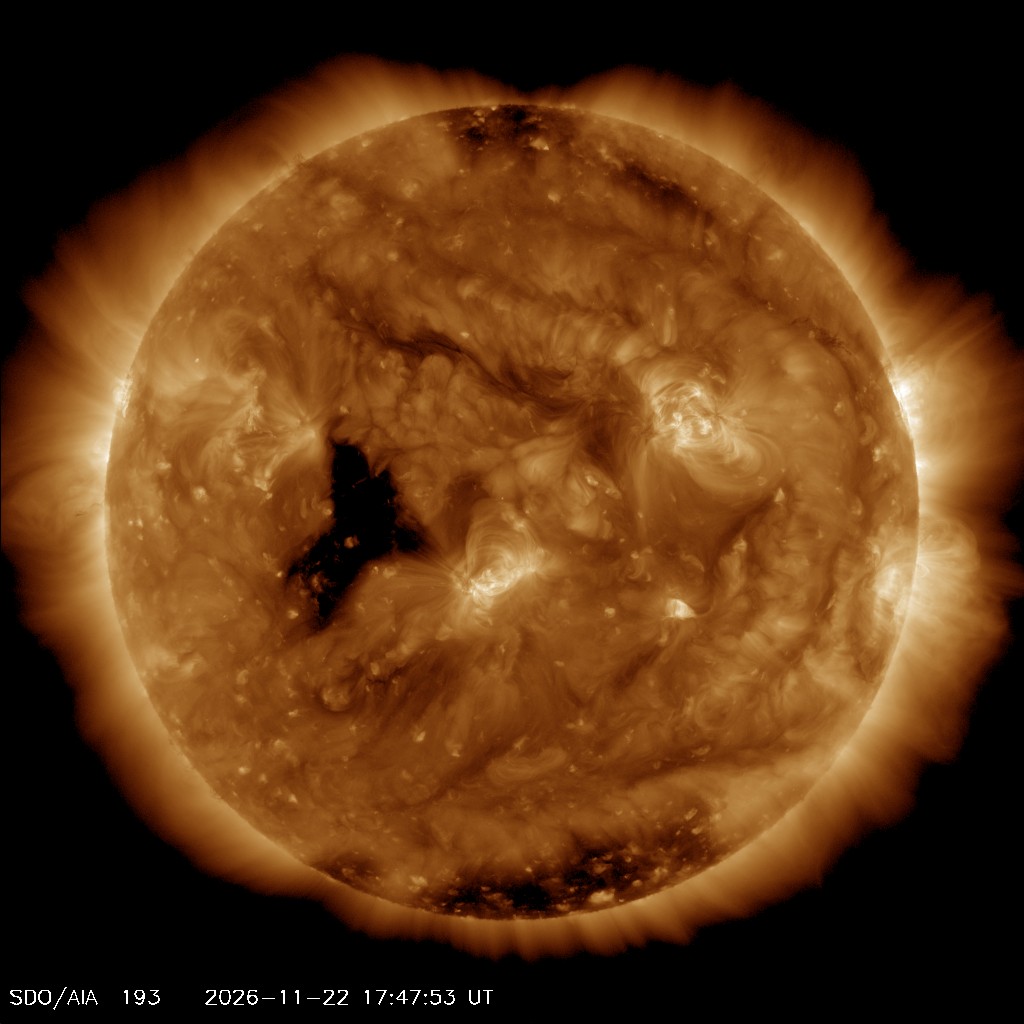
On 2026-11-20 at 12:15 UTC a coronal mass ejection (type C) was recorded with an estimated speed of 888 km/s. The event was visible in GOES CCOR-1 imagery on the northeast limb and faintly in GOES SUVI 304 and SDO AIA 171 data, but it was not clearly seen in STEREO A COR2 or SOHO LASCO C2/C3 due to data gaps.
NASA/SDO and the AIA science team. NASA imagery, no copyright; credit NASA/SDO.Source: NASA DONKI